21 years in East Africa and counting...

Friday, July 8, 2022

Back to Somalia

There’s no question that I have been able to catch up on some lost time in Somalia. It’s been something that I’ve been needing to do. Wanting to do. I always have mixed feelings about it, as I’ve mentioned before. I love connecting with staff and seeing the work on the ground. We’ve been able to accomplish so much in many of these communities. But it’s brutal to see the conditions so many others are living in and hearing their stories. It’s a harsh wake-up call that the world is simply not fair. I also don't like spending so much time away from my family.

* * *

On this occasion I would be traveling with a couple of colleagues from NY. I intentionally avoid using most people’s names, limit how much I show people in photos, just in case they’re not keen on appearing in someone’s blog. They may show up in a photo here and there but I try to keep it pretty anonymous.

Our trip would start in Nairobi where we would catch the usual 4am taxi to the airport. Travel went without a hitch and by about 9am we were navigating the streets of Mogadishu in our armored vehicle with our armed escort. Neither of the visitors had had this kind of security treatment. One of them hadn’t ever been to a setting like this at all. I think it came as a bit of a shock. Admittedly, it’s a bit strange and intimidating in the beginning for even the most seasoned traveler.

Part of it is simply the lack of familiarity. It’s difficult to be plopped down in any setting not knowing what the risks are. The longer you’re there, the more you begin to understand what you should be afraid of and what is probably an insignificant risk. A lot of it is down to perception. In the US, people have developed fears due to mass shootings that have taken place. Many of these fears are irrational given the statistical unlikelihood of something happening in your school, shopping mall, etc. but your perception of the danger can drive how much of your mental energy is spent on fear and precautionary actions.

Having done what I do for a long time, I find that some precautionary actions are simply built into me now. Some of it comes from lots of training that I’ve had. Most of the time I don’t even think about. How do I hold a bag when I walk down the street? I scan people/motorcyclists on the street to anticipate potential threat of theft. Where do I position myself in a restaurant (ex. never with my back to the door)? I always scan a room to look for alternative exits. Even when it’s unnecessary, I habitually back a vehicle into parking spaces (ready position). Most of these habits will probably be with me until the day I die.

In Nairobi, these precautions are not unreasonable. A few weeks ago when I was jogging, soon after I passed a side street, a motorcycle with two guys on it came around the corner and the guy sitting on the back of the bike took a swipe at my cell phone (in my pocket attached to earbuds). Apparently one tactic these guys use is to sit on a side street and watch passers by on a busier street. When they see a likely target, they zoom out, come from behind and rob them. In my case, the guy missed. Interestingly, he was not wearing a mask (something that would not draw attention these days and serve to hide his identity). After missing his target, the passenger looked back at me, gave me a half smile, shrugged his shoulders and they disappeared down the road.  

* * *

Our first stop in Mogadishu was a hospital that we support wedged tightly in a neighborhood not far from our office. The dirt path (not really a street) to access it is barely wider than a vehicle. Our staff, and people accessing services, generally arrive on foot or occasionally by motorcycle. It’s a good clinic though, albeit a bit cramped. It’s a corrugated metal structure, like those around it, with about twelve rooms. The drought is causing an increase in activity, particularly with regards to malnutrition cases. There must be thousands of these facilities around the world and they are so critical for the communities they serve.


colorful waiting area

Next we went to the northern side of the city. If someone follows this blog, the place will look familiar. There is no place I’ve visited more frequently. It’s a nice facility, clean, and it involves a drive across Mogadishu to get there. I feel like it’s important for visitors to experience the rather messy drive across the city to get a feel for our context. 

scars from war


turquoise waters, albeit with a bit of protection

After the visit, we went to lunch. Not just any lunch. We thought we’d treat our guests to lobster at a beach restaurant. It’s not something most people get a chance to do. I’ve done it several times and it’s not always an option given the security situation. But this time we felt confident that we could pull it off. It’s always such a treat to walk on the beach, sit for a bit and have some lunch, enjoy the view, feel the breeze, etc. Given how much one feels closed in with all the security and lack of ability to move around autonomously, getting out like this is wonderful. It’s also a glimpse of what an amazing place Somalia is, or at least could be.
lobster on the beach - future tourist destination?

* * *

The next day we were off to the interior of the country. Galkacyo is about midway between the north and the south, near the border with Ethiopia. I had just been there with a colleague a week and a half prior (see blog before last). It’s relatively accessible and a big portion of our drought response. It’s rather vast, though, and involves lots of driving on bumpy roads.

gotta love camels

The visit unfolded in similar fashion to the previous trip so I won’t repeat myself. Long drives. Sad/tragic stories. Inspiring stories. Camels. More driving. More stories. Camels. Repeat.

so many cute kids

Though I saw a few things and people that I’d seen on the previous trip, we did take some roads I hadn’t been on before. They’re not always accessible given the evolving security situation but on this occasion there weren’t any issues.

kid pretending to drive - I remember doing the same though not in a tuk-tuk

solar-powered water pump providing water during drought

It’s also a good opportunity to reflect again on what we’re doing and what we might be able to do to expedite the response. Improve the coverage. Etc. Listening to the local elders as well as those who have been displaced from their homes provide a wealth of information to my team as we adapt our interventions to an evolving situation. It’s impossible to respond to all the needs, obviously, and there are some hard choices to make – a triage of sorts – to focus on saving lives. It means not responding to some needs in the interest of more critical needs as we’re moving from severe drought to potential famine.
safe space for women and girls - skills training

tough living conditions for those displaced by drought

9 vehicle convoy - not very discreet while traveling through the country

 
roadside goat in a boat

* * *

After two days, we made our way back to Mogadishu. On the return there were no activity visits. There would only be time for a staff meeting, which was focused on our guests. I wasn’t able to attend due to a Queen’s Day event at the UK embassy, within the fortified “green zone”. I don’t generally spend much time there but it’s important for me to connect with many of the people that do. As such, I made it a priority to attend and pay my respects to the 96-year-old sovereign. We’re not sure how many more Queen’s Days there will be before they change to King’s Day.

gorgeous view from a compound within the fortified airport

It's the first time they’ve had this event since the pandemic. I attended in the years prior. You’re basically in a fortified compound which sits in the larger fortified compound. You’re surrounded by unattractive Hesco walls. (If you’re not familiar with the term Hesco, it is one of those terms that is a company name gradually becoming just a common name for lined wire 4 ft. cubes filled with sand that, when stacked, form a security barrier. They’re often the fortifier of choice given that they absorb blasts well. Unlike cement walls which fracture into small pieces (i.e. projectiles) consequently amplifying the impact of a blast.) Sharpshooters with shades stand atop the container buildings as people in suits mingle on the artificial turf below sipping juice. Alcohol is illegal in Somalia but the “green zone”, which is a fortified sea of UN and international organizations, has different rules for just about everything. Just about anything goes. However, at events that include Somalis such as this one, no booze.

Wednesday, June 22, 2022

Nairobi National Park

Between mid-May and mid-June, I have spent the majority of my time in Somalia. As the drought worsens and we inch closer to famine, it’s critical that we step up our response. It’s also important for me to see what’s happening on the ground such that I can collect footage and share the information to donors, media and anyone who will listen. The situation is dire and those who are most vulnerable are suffering the most. Understanding that there are dire needs elsewhere in the world, the scale of the situation unfolding in the Horn of Africa is truly astounding.

In between trips to Somalia, I need to be husband, dad and all the other roles that I am entrusted with. Admittedly, it's hard to do them all justice with all that is going on with my work. But I have nothing to complain about.

For example, I was able to enjoy a half-day in Nairobi National Park with family. I have to say, it’s truly amazing that Kenya has been able to preserve such a wonderful place on the doorstep to the capital city.


My sister-in-law was in town and, though she’s been on safari several times before, she hadn’t been to NNP. In fact it’s a great thing to do any time someone is visiting. I’m told they also have deals for people traveling through Nairobi with a layover long enough to do it. Cool idea.

The plan was to get up before the sun and hit the park early. In fact, the sun never got up. While not ideal for photography, it’s not the end of the world. National parks are great anyway.


The other challenge we faced was that it poured rain the night before. Though most of the roads are well maintained, to the point that it limits the mud, it can make some of the lesser roads impassible and can make some stream crossings precarious. Fear of getting stuck.

We were out of the house early though not as early as anticipated. The main entrance to the park is about 20 minutes from our house. In spite of the overcast skies, I admit that I was excited to use one of my few non-work weekend days on a game drive. It always makes me wonder why we don’t do this more.


I know NNP fairly well but not as well as I should. Generally I cruise around by following my instincts. When we would spot a group of vehicles off in the distance, it was a sure sign that there was something interesting to see. Guides communicate with each other on VHF radio or phone but those of us who are self-guided need to find other means. I also resorted to using my phone a few times to help me navigate (good cell reception close to a major city).

At one point we decided to make our way to the hippo pools. Google is detailed enough to show most of the roads within the park though it’s not clear whether they are decent. I took the most direct route from where we were. However, very quickly the condition of the road deteriorated. There were stretches that were steep and rough making it unlikely that we would want to turn around, even if we could.


After descending a rather steep section we came upon a river crossing that provided little indication as to its depth. There did appear to be a set of fresh-ish tire tracks that led to the water (and no sign of a stranded vehicle) so it gave me a bit of confidence that we might be able to make it across. That, in addition to the nasty stretch that led to where we were, gave me more motivation to believe we could make it. So I put it into first gear and off we went.

Soon after entering the water, the nose of the vehicle dropped and a wave came up over the hood and onto the windshield. This is generally not advisable, particularly when you are in the middle of nowhere. I have faith in the Toyota Forerunner (Fortuna in Kenya) like no other vehicle but everything has its limit. We were in water that was over four feet deep and we were barely halfway across.

As we plowed forward, the nose of the vehicle soon popped up and we began to climb out of the stream. The nights rains presented a formidable challenge but we made it across. The was a sigh of relief but I was still wary of the fact that we had no idea what was still ahead of us.

Thankfully, there ended up being no more major crossings, but the road threw all sorts of challenges at us until we finally came out on one of the main roads. From there it was only a short distance to the hippo pools.

We’d been in this part of the park before but not to the actual pools which requires a guide. So we decided to take advantage of the occasion and go for a short walk to hopefully see some hippos.

In the end, we didn’t see a single hippo. We heard one off in the distance as we were walking but that was all the “hippo pools” had to offer us that day. We did see other things and it felt good to get out of the vehicle and go for a bit of a walk. Sort of like a mini “walking safari”.

After finishing our walk, it was time to make our way back to the main entrance which was more or less on the other side of the park. Our goal was to make our lunch reservation at a nearby restaurant. Other than seeing a few crocodiles, hippos (finally) and a nice moment with a giraffe and her calf, the trip back to the gate was uneventful.


Mission accomplished. Time for lunch.


Monday, June 13, 2022

Drought Response - Part 3

 The road to Garowe from Galkacyo heads north parallel to the border with Ethiopia. I was told that it was built by the Chinese and is about 40 years old. In fact, there isn't much of it left. It's rough, to say the least. And some tarmac is usually worse than no tarmac. Thankfully, sections of it are slowly being re-done. But it will be a long time before Bosaso (on the Gulf of Aden) to Mogadishu is a fully paved highway (1,388km/863miles). I'm sure that those who need to use this road on a regular basis are anxiously awaiting that day to come.


Given that we have several projects along the road between the two towns, the plan was to spend the majority of the day visiting activities along the way in addition to meeting with another mayor. One thing that came up as we visited these villages was this constant them of, “thanks for your support; here are some more needs”. There is a temptation on our part to do everything we can to address these continued needs. But the reality is that there is a limited amount of resources. Those that have had some support need to understand that the support needs to be spread around. And aid dependency is a harmful drug. We need communities to increasingly wean themselves off international assistance.

life-giving water in the middle of the desert

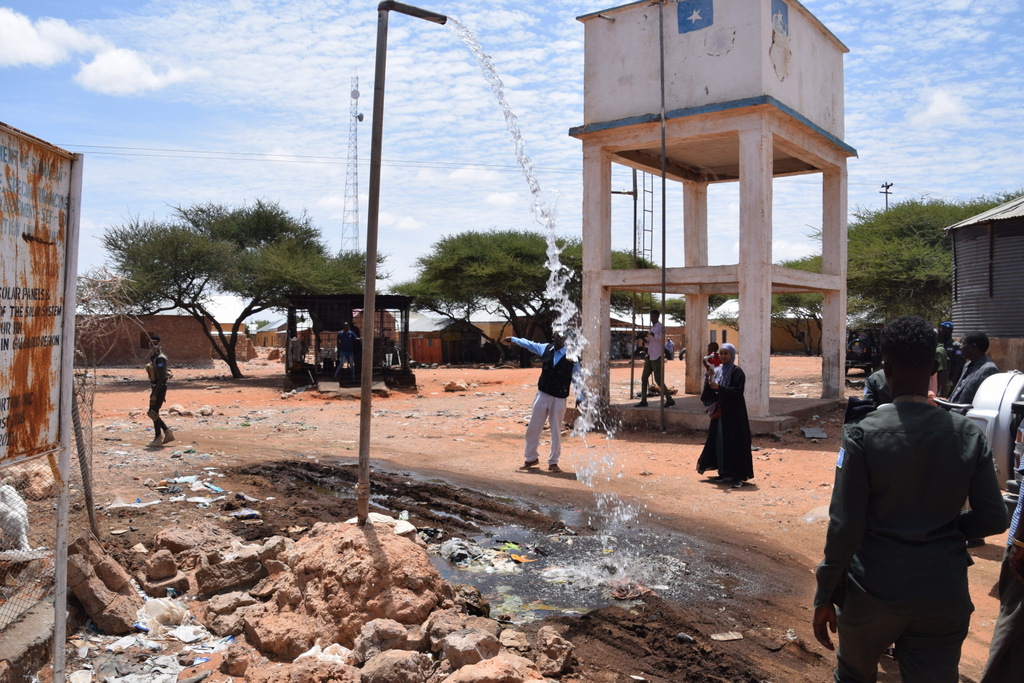
The first stop was to visit a recently rehabilitated borehole. We met with community elders first and it was apparent that they were extremely grateful for the support. Had they not had this access to water, the community would be in a desperate situation. Pleasing to hear and to see the new installation, complete with solar-powered water pump. No need to rely on a diesel generator which needs maintenance and fuel. 
these camels looked good...

...others, not so good

While we were there, pastoralists were passing through. Camels were accessing the trough. They can go a couple weeks without water. When they do access water, they drink for a while and then walk around a bit. Then they return to the water to drink some more. It takes a long time for their bodies to absorb the massive amounts of water that they draw upon when back out wandering across the desert.


We continued on to the next town. Here we saw a few things. One of them was a center for women and girls. We met with the leaders who oversee the skills training as well as the other services the facility offers. I've seen dozens and dozens of these over the years in various countries. They play a critical role in communities throughout sub-Saharan Africa. It's a safe place where women and girls can gather, learn, seek protection and access other types of support. Very cool and glad we support this sort of thing.

We pushed on. My body was tiring of the bouncy roads. I felt like my internal organs were no longer in their original locations. I've spent years and years doing this sort of thing but I don't think I have the stamina for it that I used to.

It was obvious that we weren't going to arrive in Garowe before late afternoon/early evening so our convoy stopped in at a roadside restaurant. Over the past few weeks of traveling in Somalia, we've done this a few times. They've all been similar experiences. Given that we were foreigners, we ate in a separate room out view of others to avoid revealing our presence. Service was quick given that they have large vats of rice and boiled goat. Serving sizes are more than generous. It's cheap but, given the rampant inflation in the country, it's not as cheap as it used to be. 

choose your favorite part of the goat

Soon, we were back on the road again. I think my over 17 years in East Africa, eating in a variety of eating establishments, have blessed me with a sufficient number of parasites that prevented me from any intestinal drama on the way. Very important. I would not want to be dealing with that, especially in a convoy of vehicles traveling in remote locations.

That evening we met with staff in Garowe for a couple hours and then called it a day. So tired.

* * *

The next day, it was back on the road at 7am. We headed north to the town of Qardho. I've been to this town a couple times before and it's good to share that little fact with local leaders. You can never visit people enough. They always seem to say that they don't know you or that you never come to their towns. Sometimes people will tell my staff that they have never met me when they have. It's to make a point. They want deference and they want resources.


In this case, the town leadership was all new. In fact, they had been freely election by general suffrage. I was told that it's the first town in Somalia to do such a thing in over 50 years. The mayor and the city council were not only elected, they were relatively gender-balanced and included communities that were not originally from the area (a coded way of saying that they are from other clans). That alone is pretty impressive. Because of this, you could feel a sense of urgency in the way they talked about their plans. They seem to feel a sense of responsibility (and pressure) to deliver in ways that previous "appointed" leadership didn't. It was great to meet with them and I do hope they do well. Hopefully we'll find ways to partner with them.

On the way back, we stopped at a roadside restaurant for some boiled goat and rice. I was sort of hoping to just push through and get back to the office/guesthouse but it was probably wise to stop. Though we had some biscuits and dates in the vehicle to tide us over, I must admit that the home stretch was easier with a full belly.

* * *

That evening I had a call with one of the key news outlets in Sweden. I've been in the news quite a bit lately as we're looking to draw attention to the severe drought and potential famine conditions. This interview took place in the vehicle as we were driving at night in Garowe. Always better to have these discussions while "on the ground". The interviewer likes to draw attention to that fact and, even for me, the stuff you've been witnessing is more vivid in your mind.

The last time I was in Garowe we went out for coffee/tea to a rooftop restaurant. Needless to say, it's a luxury to be able to go out like that in Somalia. Puntland generally offers an environment that is more secure - something that the rest of the country can aspire to. It was also a nice way to cap off a full and challenging trip. 

if you're ever in Garowe...

The place we went to was called "Fridays". I remember smiling the last time since it's taken from the US chain of the same name. In fact in another place the acronym was posted "TGIF". There's a slightly different nuance in the US given that its meant to celebrate the final day of the work week. In Somalia, the work week ends on Thursday so it really should be "Thursdays". No matter. The first day of the weekend also deserves to be celebrated.