21 years in East Africa and counting...

Wednesday, May 12, 2021

Pandemic Positives

I’m on my laptop in a coffee shop. It’s a place not far from where we live and they have this great African music playlist. Much of the music I know. Some I don’t. But whoever put it together has similar tastes to mine.

It’s also a pleasant experience because it means I’m out of the house. I love being at home but the return to lockdown this past month felt particularly suffocating. It was as if so much effort was put into respecting the protocols of the previous lockdown, gaining some freedom, only to be smitten down once again – likely by the selfishness of the minority who thumbed their noses at the pandemic protocols (reports in Kenya indicate that it’s likely those on the upper end of society that are having the biggest impact on the spread of Covid).

Having said that, and as I’ve said before, Kenyans have generally done well throughout the pandemic. The impact on society has been much less than in other countries around the world. In fact Africa as a whole has done better than other continents. I saw a comment this morning where someone said that people predicted doom for Africa last year and it never happened. Watching what’s happening in India right now, people are predicting doom for the continent again this year - that it's only a matter of time before all hell breaks loose in African countries. Sadly no one is acknowledging these countries’ relative success in managing the pandemic, largely because it doesn’t fit their narrative of how they view Africa. And they’ve done it in spite of the vaccine nationalism in the West and weaker health care systems. It’s pretty amazing if you think about it.

Dodging Bullets

As usual, when things get busy my posts are fewer. Given that this blog serves me as somewhat of a historical record of what happens over the years, I’ll need to back up and fill in some gaps.

We are in mid-May and in the middle of rainy season. We’ve been in Kenya for over four and a half years and this has likely been the wettest. Driving back from our friends’ house last weekend, we were in water up to our door. We’re thankful to have a vehicle high enough to avoid stalling out at times like that – particularly at night in Nairobi.

It’s bad for some families that are experiencing flooding. Many are displaced and it’s not over yet. Supposedly a lot more rain is on the way. The good thing is that it has filled the aquifers and that bodes well for the coming months after the rains have gone. We have been here in lean water years when the well of our building went dry and we relied on water truck delivery. With the irregular weather patterns caused by climate change, things have become very erratic and unpredictable. In neighboring Somalia, where my main focus is, we have had communities that were in a drought situation only a month ago and are now displaced by flooding (watershed management is a huge issue in the country though I’ll avoid going into it here). But this cycle of hardship is heartbreaking.

Politically in Somalia things became pretty intense for a while. It’s complicated but the short of it is that the president was in charge of the elections. That’s only a manageable situation if the president isn't a candidate. In a lot of countries, a president’s mandate can include setting the conditions for the elections, including establishing the electoral commission. The only people that think that’s a good idea are the people who hold power. In a country like Somalia, where the judicial system lacks the ability to provide necessary backbone for such things, it breeds chaos. On top of this, the Lower House of Parliament, who seem to be allied with the president, passed legislation to extend his term for two more years, supposedly to provide time to set up one-person, one-vote elections rather than the current representational election (as Somalia is rebuilding, it hasn’t had the capacity to carry out general suffrage voting for decades, and likely won’t be able to do so for some time). I'm very much neutral in all of this and in fact I was a big fan of the president when he took office in 2017. Moreover, the idea of general suffrage is admirable. But I haven't seen much evidence of the president's team preparing for general suffrage up to now. The fact that this is the core priority tied to this term extension lacks some credibility without some sort of transparent plan in the works. And we'll skip the topic of the constitutionality of the extension which was universally rejected by the international community.

Naturally, the president's extension set off alarm bells. People in power in Somalia are usually backed by people with guns. Within days, Mogadishu was filled with military (more than normal). A massive standoff ensued with opposition on one side and pro-govt. forces on the other. For a day or so, things erupted with open clashes and it felt as though civil war was inevitable. I was in Mogadishu for the previous election, which was tense, but nothing like this. Thankfully, I was not in the city for this. After being there for the 8-hour militant hotel siege a couple months ago (not far from where I stay), I’ve had my share of grenades and gunfire for a while.

I’ve been asked about the situation in Somalia on a number of occasions recently, including by journalists, and I’ve generally said that the key stakeholders have too much to lose if things deteriorate into full on civil war. I’ve felt that they might take things to the brink to pressure adversaries, but that conflict wouldn’t serve their interests. Unfortunately it was beginning to appear that I was wrong – that people were ready to double down, even if it meant massive bloodshed. Somalia has seen this before and in the past, the business of conflict outweighed the business of peace. There is money to be made either way, but with the economic progress made, particularly over the past 5-10 years, it seemed to me that the business of peace (trade, hotels, real estate, etc.) might outweigh the business of war (weapons, security, logistics, etc.). 

At the eleventh hour, the president announced that he would work with the Lower House to nullify the two-year extension of his presidency. There was a collective sigh of relief. Someone told me that he heard gunfire soon after the announcement and there was fear that it might have been people who didn’t accept the decision. In the end it was celebratory shooting in the air (which needs to stop, by the way; our guesthouse in Mogadishu is hit by stray bullets on occasion).

Rarely is the expression “dodged a bullet” more meaningful. Though we’re not out of the woods, there is hope that the elections can move forward in the next few months without too much trouble. The president has turned over the preparations to his broadly trusted prime minister. I knew the previous PM but I’ve never met this one. But he seems to be a pretty likeable and competent guy. The pressure is on.

So we’ll see. Yesterday morning, just as I was planning my return to Mogadishu, the Kenyan government announced that it was banning all flights to Somalia. Ugh. This is connected to a long-standing spat between the two governments which I won’t go into now, but it will unnecessarily complicate things.

Today my newsfeed is filled with outrage at the treatment of Palestinians. The good news is that much of the news of chaos in Somalia has subsided – for now. The bad news, of course, is that the plight of the Palestinians continues unabated. All this tends to make one weary. There are so many people like me with their finger in the dikes of the world, trying to hold back the tiny leaks of water, to make sure that those in need are provided for and that they have a voice. At the same time there are great forces at work that undermine the smaller efforts of the masses. It’s a problem that is as old as time. It can make you cynical. But it’s encouraging to see others that refuse to avert their eyes, that get up each morning to fight that good fight.

Sunday, April 18, 2021

Elgin in Idaho

 As I was scrolling through my work Twitter account last week, I became aware of the passing of Prince Philip, Queen Elizabeth’s husband. It’s very sad, of course, for their family and for many who closely follow the royal family. I wouldn’t say that I do, though I did watch the Crown series on Netflix. I’m not sure how accurate Philip’s portrayal was but all indication is that he was an interesting man and the actor did a pretty good job of portraying him. It mustn’t be easy being married to the Queen, not because of her necessarily but because of the role. I likely won’t have to worry about it.

* *  *

Another recent death was Elgin Baylor. I would guess that most of the world has no idea who he was. Granted, he was in his heyday as a professional basketball player many decades ago before entering the NBA Hall of Fame. Back then the sport didn’t make superstars of people as they do now and there’s obviously a limited amount of footage floating around showing him at his craft. But Baylor was a legend and many believe he was one of the key players to transform the game into the modern era. His style laid the foundation for players Magic Johnson, Kobe Bryant, Michael Jordan and Lebron James.

Growing up a huge basketball fan, I couldn’t get enough of the sport. I tried to imitate all the great players of the time. Though Baylor was passed his prime when I was a kid, I nonetheless was familiar with his contributions to the sport. What stunned me as a child was to find out that he had actually, and briefly, went to the same college as my dad.

I’ve been fascinated by history since I was a child. The intersection of sports AND history was even sweeter. Add to that a family connection and you have the trifecta. I would crack open my dad’s yearbook time and time again to study the old photos. There was Baylor in black and white.

And speaking of black and white, a person having even a cursory understanding of history will know what things were like well before the civil rights movement. Baylor grew up in Washington DC and was already a legend thanks to his high school career. However DC, which was segregated at the time, offered him few playgrounds where he could hone his skills growing up. But he excelled nonetheless and finished high school as one of the top players in the country. The problem was, of course, that few schools were recruiting, or even allowing, black players and his options to get a scholarship were limited.

It’s a long-ish story but a friend of his, who was also black, had a connection to a small college in Idaho (a neighbor had a brother who played for the Harlem Globetrotters who told Williams that, during the traveling troupe’s recent visit to Idaho, he heard about a college in a small town that was looking for athletes of any color). For Baylor, having rarely left Washington DC, the idea of going to school out West would be a huge change. But Baylor recounted the phone conversation in 1954, his friend said, “Come to Idaho!” He replied, “Where’s Idaho?”

You couldn’t get much whiter than Caldwell, Idaho, at the time. It’s hard for me to imagine what it was like for him to adjust to life in the West. Same country. Different world. But he wasn’t alone. The coach knew he was tapping into a fountain of talent and opened the door to more of their friends. The team ended up with six Black players altogether – something that was unheard of back then. One of the players, upon seeing Idaho for the first time, said, “I’d never seen anything so beautiful.”
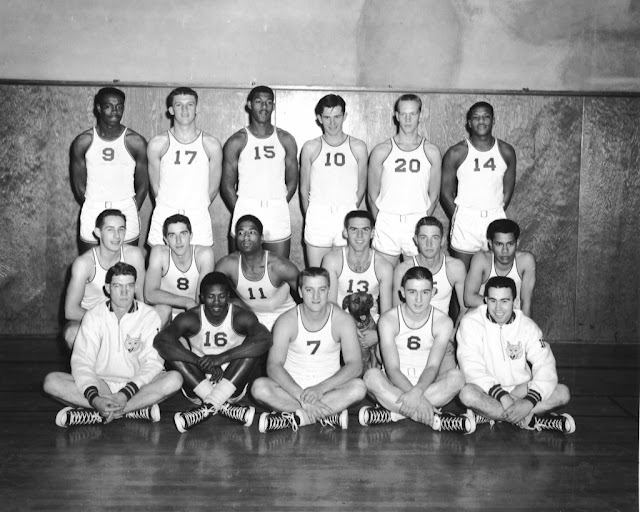
courtesy of C of I
courtesy of C of I

The team ended up with a record of 23-4 for that season. They went undefeated in league play for the first time in the school’s history and maintained an 18-game win streak. Baylor broke every major scoring record, averaging 33 points a game, including 53 points in a single game. But the magic was more in the way he scored that left impressions. The quickness, the dunks, the passing, etc. were something the region had never seen before, and would not see again for some time. The 1,000-seat arena was packed the entire season.

All that is interesting in and of itself, but what I find even more interesting was the overall experience that Baylor and his friends had during their time in Idaho. The son of Baylor’s friend (that initiated the whole thing) said that his father never expressed anything but joy about their time so far from home. “To hear Dad or Elgin or Gary (the guys from DC), they talked about Idaho like it was the time of their lifetime.”  The only racial profiling Baylor noticed in Idaho was of a sort that amused him. Lots of white classmates asked him for music recommendations or dance lessons. He always complied. “It feels as if W.W. and I have wandered into a private and exclusive members-only club,” Baylor wrote about the experience, “but rather than feel intimidated or excluded like I do in D.C., I feel invited.”

While it warms my heart to learn that the experience Elgin Baylor and his friends had in Idaho was positive, I realize that the state has had, and continues to have, its share of racist behavior. Since I left Idaho, I’ve lived for 26 years as a cultural minority, including 16 years as a minority in Africa. I’m fully aware that my experience cannot compare to that of a Black minority in the US. The evidence of institutional racism in America continues with no end in sight. In fact my experience has probably been more similar to that of Baylor’s in that my ethnicity has generally been seen as a novelty (reactions have varied depending on where I’ve lived). But it’s almost always a thing (less so in Nairobi). It gets old but I’m much less in fear of being unfairly arrested and/or killed by bigots.

Speaking of standing out, I recently heard a story about Jackie Robinson, the first Black person to play in Major League Baseball. On that momentous first day (April 15, 1947), he woke up early at the McAlpin Hotel in NYC. On the subway to Ebbets Field he told his wife Rachel, “Just in case you have trouble picking me out, I’ll be wearing #42.”

I’d like to think that all of this exposure to the ugliness in the US and elsewhere (thanks in part to phone cameras) is slowly nudging things in the right direction, thanks to some accountability. It’s hard to tell but it’s probably mixed. I suppose some things are getting better and in other areas people seem to be doubling down in their bigotry, and not only towards African Americans.  

The story of Elgin Baylor’s time in Idaho (he would only stay for a year) is a positive one and one worth celebrating for a lot of reasons. He was a pioneer in many ways and this was a small, albeit meaningful, chapter in the life of an amazing talent.