21 years in East Africa and counting...

Saturday, June 14, 2025

Soysambu - Day 2 & 3

Day 2

Breakfast on the Lake

setting up the breakfast
 

The next morning, breakfast would be next to the lake which was a short walk from our camp. The skies had cleared after the clouds and rain from the previous evening. The temperature was cool and sunny – perfect for an outdoor breakfast. They had brought a small cooker with them and were able to prepare bacon, eggs and toast. It was quite the spread. 
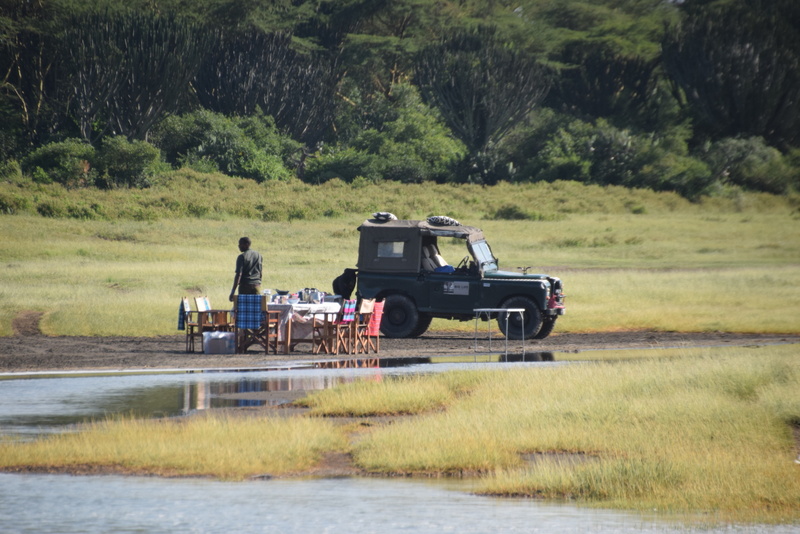
 

Nearby on the lake were flamingos, pelicans and various sorts of other birds. On the other side, zebras were grazing. Pretty idyllic.


After eating, we walked along the edge of the lake, enjoying the wonderful weather and setting. Eventually, we would make our way back to camp to read and relax until lunch.


Caves

In the afternoon, we headed out on another drive. This time our primary destination was a cave network about 20 minutes away. I often do my homework in advance of going to a new destination, but, in this case, I confess that I was unaware that these caves even existed.


The caves are an abandoned diatomite mine. Diatomite (diatomaceous earth), I discovered, is a white chalky substance composed primarily of fossilized diatoms, a type of algae. Which means that the lake near our camp was much, much bigger millions of years ago. Diatomite is used in everything from toothpaste to roads, cat litter, filters, polish, etc. Who knew.


tinier opening

There are multiple entrances to the caves, some of which were barely big enough for someone my size to fit through. I’m somewhat claustrophobic so it was a bit uncomfortable at times. Thankfully, most of the tunnels were decent-sized once you were inside and I could often walk upright. I did bang my head a few times, but the texture of the diatomite is soft so the result was getting the chalky, white dust all over me.


We were told in advance that we needed to bring headlamps, and they turned out to be essential, particularly once you start winding your way around the tunnels no longer in sight of the entrance.


lots of bones


The Lion King hyena den - eerie similarities   

The guide referred to them as “hyena caves”, and there was plenty of evidence that it is a popular hangout for them. There were bones everywhere. Thankfully we didn’t see any hyenas in the caves at the time we were there. I would think that encountering them in their den could be quite dangerous. But it is indeed an eerie and surreal place. It made me think of the hyena den from The Lion King.

I read later that these caves usually have tons of bats, but I didn’t see or hear any. They also supposedly provide shelter for lions. Who knows.

crested cranes

* * *

After the caves, we drove around a bit more and then headed back to the camp for tea. In the late afternoon, our guide proposed sundowners near the lake. At the time he proposed it, it had been raining. I would have wanted to do it rain or no rain, but I know not everyone enjoys “bad” weather like I do. In the end, the rain stopped, and we were able to enjoy drinks by the lake, albeit clouds obscuring the sunset.


That evening, we had another nice dinner, celebrated a birthday, spent some time by the fire and then retired to our tents. During the night I was awoken at about 2am by the sound of someone walking near the tent. I thought it was probably one of the staff keeping watch during the night. But then it sounded like two or three people. As the sounds became closer, it became clear that it was animals rather than humans. I got up to peer through a screen on the back side of the tent and in the dark I could see the silhouette of a buffalo. Eventually I would see three of them, munching grass and working their way around the tent. These guys are massive when you see them up close and they can be dangerous. I’m glad that I didn’t encounter them the previous night when I stepped out at around the same time to pee. 


 Day 3

The second morning that we were there, we had breakfast outside but not at the lake. We would need to break camp by 10am so there wasn’t time. The setting at the camp was still quite wonderful, with a couple of giraffes grazing in the distance as we sipped our coffee.


After saying our farewells to the others, we headed out. We decided to take a different road – one that was more obscure but more or less headed generally in the direction we needed to go. I do enjoy exploring new roads. I assumed that the worst that could happen is that we hit a dead-end and would need to turn around. In the end, we were able to find our way to the gate. Having cell reception can make you a bit more daring than you would be otherwise.

From the gate, it took less than two and a half hours to get home. Driving on Kenyan highways is not for the faint of heart. I read recently that Kenya has the highest rate of road deaths per number of vehicles. I don’t know if it’s true, but I do know that there are lots of accidents, including an ugly one that we saw a few years ago on this road. But this road does offer some great views at times, including the Rift Valley from high above and Mt. Longonot, the extinct volcano that we climate a couple years ago.

Apparently, the train from Nairobi used to pass through Soysambu back in the day. That would have been cool.

Off to Mogadishu one more time and then we’ll get a vacation next month. Can’t wait.


Soysambu - Day 1

A few months ago, we made arrangements with some friends to go to Soysambu, a wildlife conservancy about two and a half hours north of Nairobi in the center of Kenya’s Great Rift Valley. Last weekend, it was finally time to venture out to this wonderful tented camp overlooking Lake Elementaita. 

We had been to this part of Kenya back in 2017 but not to this conservancy. During that visit, we stayed in a rather shoddy hotel on the shores of the lake. It wasn’t overly eventful, but I do remember lots of beautiful flamingos and our daughters drawing all over each other with colored pens (while we were in another room trying to take a nap). This time, the girls are eight years older and are far different travel companions than they were back then.

The Conservancy

Conservancies allow people, either on their own or with other properties, to turn massive land holdings into large, protected areas for wildlife – sort of like a national park but on private land. These landowners can then earn income by leasing that land for safaris, lodges and other tourism activities. Or they can run these businesses themselves. And, from what I understand, landowners are further incentivized through property tax exemptions (though they are taxed on any revenue generated on the land).

This particular conservancy sits on land that has a long and storied history that I won’t go into here (though I think I might have touched on it in a previous blog a few years ago). But there have been many books and a couple of movies based on lives of the settlers to this area – colonial era aristocrats who developed the land by day and had cocaine-fueled, wild parties by night. The peak of this debauchery took place in the interwar period of the 1920s and 30s. When Kenya gained its independence in December 1963, many British left the country to start their lives in England. Many others, including a lot of these landowners, remained in the country and took on Kenyan citizenship.

Soysambu’s original owner settled on the land in the early 1900s, a nobleman from the British aristocracy, and was one of the early English settlers in Kenya. His line of Lords/Barons have run the property through to this day, though the depravity has apparently subsided. It’s now a modern, forward-thinking conservancy that integrates agricultural production with wildlife conservation. The adjacent Lake Elementaita is a UNESCO World Heritage Site. The conservancy has about 450 recorded species of birds and there are over ten thousand species of wildlife altogether. It has some of the biggest flocks of flamingos in Africa.

* * *

Day 1


We arrived at the conservancy by mid-afternoon. The two other couples had arrived not long before we did. We settled into our framed tent and returned to the common tent (with comfy sofas and a dining area) to have tea and soak in the wonderful setting. This time of year, post-rainy season, the areas is green and lush, and the temperature was ideal. From where I was sitting, I could see the lake off in the distance. Zebras and elands were grazing nearby. Monkeys were playing in the acacia trees to my right. It was a stark contrast to our noisy, urban setting in Nairobi.


the camp with Lake Elementaita in the background

There are no fences except for a string that is tethered between some small metal stakes that encircle most of the property, I assume as a minor deterrent for the wildlife. I have to say, I can’t think of any creature that would be deterred by a small string about two feet off the ground. We were told that buffalo ignore (trample/step over) the string and graze around the tents at night (which they did), so we were not to wander about after dark.

 * * *

After relaxing and catching up with our friends, we headed out in a couple of 4WD vehicles to do some exploring. Our conservancy booking included support staff, one of which doubled as a guide. He said there was a pride of lions about 30 minutes away so we thought we would go on a little game drive before dinner.


eland

The roads in the conservancy are quite good, though I understand why they say it is 4WD only. Along the way there were loads of animals including elands, impalas, gazelles, buffalos, baboons, zebras, warthogs, giraffes, hyenas, etc. For some reason I expected that there would be fewer animals than you might find in a national park, but that was not the case. No rhinos, cheetahs or elephants, however.


It was cloudy and cool, and I expected it to rain at any moment. Though I love the rain, I was hoping it would hold off until we were headed back to the camp. Animals usually seek shelter if it rains very hard and that obviously makes them less visible.


waterbuck

After driving for about 30 minutes, we spotted another vehicle off in the distance parked near the base of a hill. We hadn’t seen any other vehicles to that point, and I was hopeful that this was someone checking out a lion pride. And indeed, it was.


true confessions, this was taken by one of our friends (who had a much better lens)

Other than the fact that the lighting wasn’t great, the scene could not have been more ideal – a couple of lionesses lounging with their cubs. I think we counted nine lions altogether. The cubs were playing, nursing, being cleaned by their mothers. Insanely cute. I love shutting off the vehicle, enjoying the quiet and just taking in the setting. There was a cool breeze blowing and an occasional sprinkle of rain.


money shot, again, sadly not mine

We must have stayed for about a half hour. Eventually the rain began to pick up and the lions began to edge back into the brush. It was time to go. We began to make our way back to camp, spinning in the mud a few times, occasionally slowing to allow animals to cross in front of us. Always nice to arrive at camp after a successful trek in the bush. 

In the evening, the guys made a big fire. It’s so great to sit by a fire in a bush camp. You could hear hyenas yelping in the distance along with other sounds of the savanna at night. Eventually the staff brought our dinner. We had a nice hot meal, some wine, good conversation, then off to our tents.

Thursday, June 5, 2025

20 Years in East Africa

As I type, this day marks my 20th anniversary of my life on the African continent. Exactly two decades ago I arrived in Dar es Salaam, Tanzania, to begin what I thought would be a relatively short chapter of my life to do some good work to support the people of the country but also mix in some fun exploration and adventure (possibly a Mt. Kilimanjaro climb). I didn’t set a specific timeline as to how long I might stay but I assumed it might be something like 2-3 years.

adventures in California - seems so long ago

I had tucked in to a nice life on the coast of California. I had taken up surfing, triathlons and had been doing plenty of adventures in the back country. Professionally I wasn’t very satisfied and was barely making ends meet, but I was comfortably distracted by my non-work life.

That all came to an end as the Harvard School of Public Health offered me an opportunity to set up logistical and financial systems to manage a multi-million-dollar HIV/AIDS project in Tanzania. Though the hiring process would take months and involved a certain degree of uncertainty, I threw caution to the wind and began dismantling my California life. I put my belongings in storage and would move from the Pacific Coast to the Indian Ocean coast.

* * *

I remember arriving in Dar from Boston late at night, exiting the airport into the warm, humid tropical air. Two guys from our project, one from India and the other from the US, were there to pick me up. I remember driving through the city just before midnight staring out the window at what would be my crazy new world. Though I had traveled a lot in my life up to that point, my only experience in Africa had been a couple of months in the Cote d’Ivoire in West Africa in 1990. This would be a vastly different experience.

my first couple weeks in Dar, my vehicle would the the one on the left, Priya's cool truck is on the right

We arrived at the large but rather simple guesthouse not far from the center of the city. I would be staying with about a half dozen other expats from various countries, all of whom were involved in the research side of the project. I found out quickly that there was always a bit of a stir when a new person arrived to work on the project. There were lots of questions and I did my best to fend them off given that it was now after midnight and I was functioning on little to no sleep and eight hours of jet lag. Eventually I was able to drag my bags to my new room, turn on the fan, slip under my mosquito net and pass out.

One interesting side note about my arrival is that my future wife was among the interrogators. Somewhat ironically, she was probably the least curious of the group, barely getting out of her patio hammock to greet me. In her defense, she did have a boyfriend at the time and she was a bit embarrassed by the attention I received from the others.

Adapting to life in Dar was a fascinating and rich experience. Though I worked long hours, I took advantage of my weekends explore the country. And yes, Mt. Kilimanjaro was checked off my to-do list.


* * *

Kibondo/Dar

By 2007, I had changed organizations and Priya and I had married. We were offered positions in a remote part of northwest Tanzania. It was one of the most difficult jobs I ever had but it was possibly the most rewarding, supporting four rather large refugee camps. 

a year in remote Tanzania

Having a high-pressure job, living off the grid in a tiny house with a squat toilet in the middle of nowhere was an acid test for a young marriage. But it turned out to be quite wonderful. Not only did we survive, we seemed to embrace the whole experience. I was almost reluctant when the call came a year later with an offer of a promotion and an opportunity to move back to Dar es Salaam. In the end, it made sense to make the move and by the beginning of 2008, we were back in Dar. I would still be overseeing our work in the country, but now it would be dealing with the politics and donor relations. 

Priya

me

We did have plenty of adventures and it was a fantastic period in our lives, but after two and a half years, I was offered the opportunity to move to Bujumbura to oversee the organization’s programs in Burundi and Rwanda.

* * *

Bujumbura

Though we enjoyed our time on the coast, professionally I felt the need for a new challenge. Plus, given that I already spoke French and had been working with Burundian refugees, I was particularly well-suited for the new position. In retrospect, it turned out to be a good move. From 2010 to 2014, it was an amazing time. We grew to become the largest non-governmental organization (NGO) in the country. The work we were doing was changing lives and it was exciting to be a part of it. But more importantly, it was during this time that I became a father to two daughters.

becoming parents in Burundi

Though Burundi has perpetually been wracked by bad governance and corruption, it’s still a wonderful place. It’s stunningly beautiful, has perfect weather year-round, and the people are (generally speaking) delightful. It was also a great place to have small children (as long as you don’t need much pediatric care) and we ended up staying longer than I thought we would. 

remote Burundi

By 2015, however, the wheels, fragile as they were to begin with, began to come off. Violence was on the rise and nightly gunfire became increasingly concerning. Eventually there was a failed coup attempt and things began to spin out of control even further. The majority of the international community fled almost overnight, mostly by road since the airport had shut down. Needless to say, it was a frightening time. I stayed behind but my family would eventually need to be temporarily evacuated to Rwanda. It was ugly and sad. With occasional bullets reaching our house, it was time to explore other options. Having children in this environment was becoming increasingly irresponsible.

Nairobi and the Somalia Program

It took a few months but eventually I was able to make a switch to the Somalia country program in the latter part of 2016. Indeed, it would be out of the frying pan and into the fire, but the family could be based in Nairobi, and they would be more or less out of harm’s way. As the girls were getting older, Nairobi provided more stimulation than the sleepier Bujumbura, and it would make more sense in the long run.

 displaced in Somalia

But working in Somalia has lived up to its billing as a daunting posting in many ways. Admittedly, it’s an acquired taste. It’s been a wild ride with chaos seemingly around every corner. I’m well beyond the shelf-life of the average expatriate in my position, but yet I still remain. The interesting thing about this context is that, at least for me, it has a seductive side to it. Though it’s harsh and difficult, I keep coming back for more. I have a great team. We’re doing some amazing work. And geopolitically, it’s one of the most fascinating contexts in the world. But, admittedly, it is wearing me out.

* * *

No Good Deed Goes Unpunished

Twenty busy years in a nutshell. Despite the insecurity. Despite the corruption. Despite the world’s disregard for the humanitarian impact of climate change. Despite the damage caused by the disappearance of funding. I still get up in the morning and take the punches. I guess it’s because I still believe in what we’re doing. I still believe that the marginalized of this world deserve our attention, regardless of where they live and what they believe. It would be a lot easier to just walk away and pretend that the suffering isn’t there or that it’s not my problem. But I can’t unsee the things I’ve seen over these last two decades. I cannot turn my back.

“Compassion is not weakness and concern for the unfortunate is not socialism.”

-Hubert Humphrey, US Vice President (27 May 1911-1978)

How long I stay remains to be seen. Regardless, I’m thankful for all the crazy experiences and wouldn’t change a thing.