21 years in East Africa and counting...

Tuesday, January 4, 2022

Idaho for the (pre)holidays

Over the years I’ve generally been quite good about not taking time with family for granted. When the pandemic hit, it was reinforced all the more. When an opportunity arises to be with my kin, I take it.

Every year I’m allowed a home leave for me and my family to visit my home of record. It’s a benefit that is more or less standard for people who hold international humanitarian positions. Private sector provides similar support (though likely with a few more bells and whistles). My home leave falls on the anniversary of my start date which was in December. It’s handy, in a way, since it means that it always falls around the holidays. As such, having spent most of my life outside the US, I’ve still only missed two Christmases away from family. Last year the pandemic prevented my family and me from spending the holidays with our families in the US – one of the only two that I missed.

* * *

This year we decided to begin the holiday in Idaho with my family and then head to southern Indiana/Louisville to spend time with Priya’s family, about ten days with each. The girls’ school vacation sort of dictates when we travel nowadays and that’s the way it’s going to be for a few years.


The challenge in frontloading the Idaho part of the trip is that we would arrive and depart before the 25th – missing both Christmas and New Year's. Even in Indiana, we would leave by New Year’s Eve (on the flight as I type).

The pandemic is still very much an issue as the omicron variant has spread throughout the US (and around the world). Though our travel went without mishap, thankfully, family activities would nonetheless end up being shaken up a bit. Even before traveling there was considerable discussion about the presence of anti-vaxers at the various gatherings. There was also concern about us, though we were tested the morning we left, we could potentially be exposed on the way there, including within the US where no testing is required for internal travel Though more than 90% of my family (including spouses, children, etc.) are fully vaccinated and have been cautious, there are a couple of holdouts. I was more sympathetic for those who held off due to uncertainties around the virus during its first few months. But now, with its effectiveness and safety more than verified, people just need to step up. And share their vaccines with places like Africa.

As such, family gatherings were a bit more broken up into smaller groups. I tend to like it that way anyway. Conversations are better. When you have 30+ people in a room, including some tots running around, it’s next to impossible to really find out how people are doing and have meaningful exchanges.

We spent a few days with the Boise-based family before heading down to see my parents. Jet lag didn’t seem to be much of an issue. Even our girls are getting pretty good at managing the effects of time differences, though heading east to west tends to be easier than the opposite.

We did get some snow in both Boise in Kimberly. Not a lot but it was enough to make a snowwoman. But bigger snows were on the way.

We had planned on sneaking in a first ski at a small ski area called Pomerelle near where my parents live. We geared all up and headed out. It’s not a bad drive, particularly as you get up into the area where the mountain is. We’d checked the website just to make sure it was open. The site provided all the normal information including snow and weather reports, ticket prices, etc. The one thing it failed to mention was that it, in fact, wasn’t open. Apparently, word of mouth still rules in these small communities, something one isn’t privy to when arriving from abroad.

Growing up we’d never known Pomerelle to be closed the second week of December. It tends to get more snow than other ski mountains in Idaho due to where it’s situated. In any case, we made it all the way to the parking area covered with nearly a foot of fresh snow, only to see the sad, motionless chairlifts.

We headed back to the town of Albion located at the foot of the mountain. It’s an area steeped in history, including that of my own family, and I always like going there. It was very quiet and several of the few businesses appeared to be closed. We stopped at a place that had an “Open” sign illuminated. The door was unlocked but the place was empty when we walked in. Soon a guy came out who seemed to be surprised he might have some business. Formerly a restaurant, the place was now a store. We were able to order a couple of hot chocolates for the girls and we chatted with him for a bit. Found out at the end of the conversation that he was the mayor. Not sure why that surprised me. For a rural town with less than five hundred people, chances are a bit higher that you might accidently run into the mayor.

After our failed ski adventure, we opted on a trampoline place so the girls could burn some energy. Exercise is good for getting over jet lag and this was one of the few options I could think of. I was still nursing a broken arm/thumb and jumping on a trampoline is probably the worst activity for such a condition. So I was relegated to spectator.

Otherwise, we shoveled and played in snow, and hung out with my parents. It’s always a low-key time but always relaxing and enjoyable.

* * *


We then headed north to the mountains. For me it’s a core part of the holidays – time to be in the big snow, ski, sled, etc. I was more limited in my activities due to my broken appendages but it’s always a special time for the kids who have been raised in the tropics of Africa. We met my brother for lunch and then made our way to the local hot springs. Taking an outdoor dip in the water in the middle of a snowy winter is wonderful. This valley (where we bought property a couple years ago) is such a magical place with all that it has to offer. At least in my opinion.
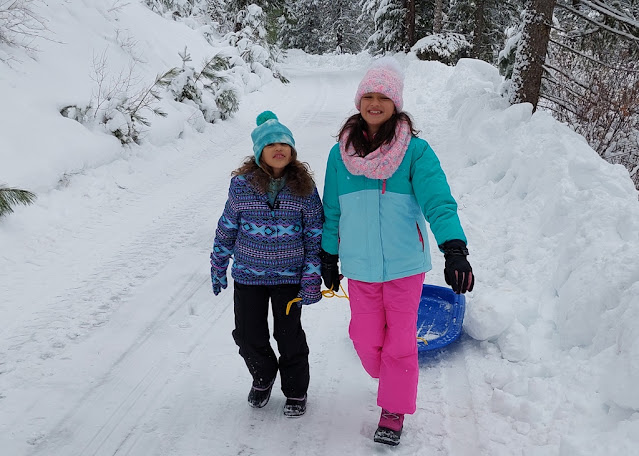
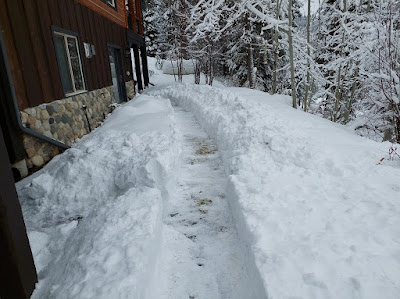
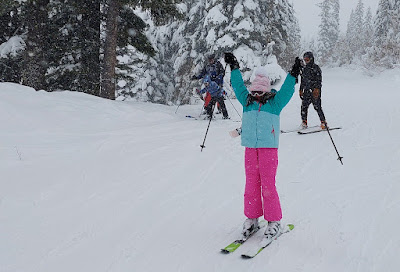
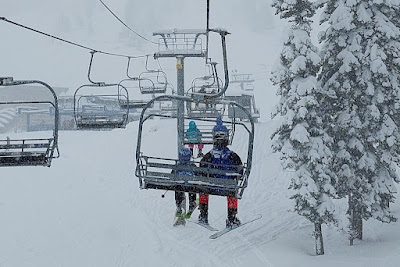
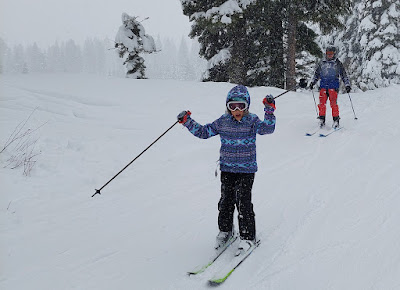
Then it was off to my sister’s rather large cabin to spend a couple of nights in what was a real winter wonderland. We relaxed, had steaks and enjoyed time with family. We also met with a contractor at our unfinished house to see if we can’t get it done, in spite of all the demand on contractors these days. We had a chance to ski, finally, though the snow was relentless. It was that cold, dry, fluffy snow that makes for good skiing though visibility wasn't all that great. Sadly, we didn’t have much time to enjoy it before we needed to get back to Boise to prepare for the second leg of our trip.


* * *


The last day or so before traveling is usually more work than fun. We return winter things to storage. Run last minute errands. Etc. We squeeze in time with family but it tends to be rushed. In addition, we were watching an increasingly precarious travel situation with the spread of the Omicron variant. Thankfully we had no disruption and were able to make it to Louisville without drama.


Tuesday, December 7, 2021

Keep the rubber side down

When I arrived in Africa in May 2005, I decided to bring my mountain bike. In fact it was a fairly nice piece of equipment and I thought it would be a nice way to explore during what I thought would be 2-3 years on the continent.

But during my first week in Dar es Salaam, I received a sobering message about what riding here can entail. We heard that one of our guards had taken a machete to the head as someone stole his rather old, Chinese, single-speed bike. We went to visit him in the hospital and, thankfully, he was conscious and we were told that he was going to be okay.

As I left the hospital, my head was spinning, not only about what had happened to him, but the kind of environment I was now in. I had just moved to Tanzania and I was still adjusting to my new reality. I was already getting used to expats sitting around talking about the latest crime that happened to them or someone they knew. This poor guy was riding a relatively cheap bike and got smacked. I could only imagine what someone would do to get mine. I ended up using it sparingly in Dar until I moved to Kibondo (rural NW Tanzania) where I would use it more. I had one or two interesting moments there but overall it was a much nicer place to ride.

riding near one of the refugee camps where we worked

* * *

In early November I had a bit of a bike accident while sailing past the snarled Monday morning Nairobi traffic. It was nothing sinister but rather a simple clipping of a pedal on a cement divider. My mountain bike flipped and I took a nosedive onto the bike path. It happened rather fast and didn’t involve any pedestrians, motorcycles or cars. Just my own, somewhat uncoordinated, self.

I was wearing a helmet but that did nothing to protect my front paws. As I got to my feet, I knew right away that I had at least broken my right wrist (technically the end of the radius in my forearm) and probably my left thumb as well. My flash self-diagnosis ended up being correct, far from being my first fractures of this kind.

For better or worse, I made the decision to soldier on to the office and call Priya from there. With hands shaking a bit from the freshness of the accident, I gritted my teeth and eventually was able to get my chain back on. As I was doing so, a beggar with bad timing decided to try to hit me up for some change. I don’t know if he saw the accident or noticed my scuffed-up clothing, but it probably wouldn’t have stopped him from taking his chances on a temporarily immobile foreigner. I raised my head briefly from looking down at my chain and greasy fingers and gave him a look I’m not proud of. But it did nonetheless quickly deliver a message that he needed to move on.

Thankfully the bike was mostly unscathed (given that it had conveniently landed on me). I mounted and trudged up the hill, albeit a bit wobbly. It soon dawned on me that hands are quite useful when riding a bike. Not only do they assist in supporting your torso, it’s how you change gears and access your brakes. I momentarily questioned the wisdom of my decision to carry on but after a few minutes, it appeared that I was going to make it the full mile and a half or so to our office building. Once at my desk, I called Priya. She dropped what she was doing and would proceed to spend the next five+ hours with me navigating the emergency/accidents process at the hospital.

Thankfully I haven’t spent much time in the healthcare system here. I hope it stays that way. This particular trip was a mix of surprising efficiencies and surprising inefficiencies. But the entire process took way more time than was necessary, and it even could have been longer had we not pushed a bit. Priya facilitated some things for them and I opted out of getting measured for a sling. Otherwise it would have been even longer.

One thing that was interesting was that the x-ray of my right forearm/hand revealed evidence of half-dozen or so previous breaks from years’ past, including a bone chip floating among the carpal bones in my wrist. My left x-ray was more modest with only three or four previous breaks. Not good memories.

a more sedate ride with family in Nairobi
As we got in our Uber, I stared at my forearm cast and thumb splint with my mind racing, thinking about how the day’s events would impact the next couple of months. I was in considerable pain but I was distracted by my thoughts. My trip to Somalia the following week would necessarily be canceled. Without the use of either thumb and the fingers on my right hand, no opening containers, no buttons, zippers, shoe laces, typing, driving, writing, etc. etc. until further notice. Ugh. Except for walking, I was hard-pressed to think of things that I would still be able to do.


I find the expression “all thumbs” a bit puzzling. I’ve never used it but I’m familiar with the fact that it means “clumsy” or “awkward”. Try having no thumbs. Now we’re talking clumsy. It’s amazing how critical those things are. Once again, I am reminded of the challenges faced by the disabled. Mine, thankfully, are just for a few weeks.

Friday, December 3, 2021

Cherries and Cockroaches

The psychologist, Paul Rozin, has said that a single cockroach will completely wreck the appeal of a bowl of cherries, but a cherry will do nothing at all for a bowl of cockroaches.

I read a book recently called Thinking, Fast and Slow by Daniel Kahneman. Among millions of other things, he argues that people tend to remember the negative much more than the positive. If I say five positive things about you and one negative, you’ll invariably dwell on the negative thing I said. It’s human nature.

This sort of thing prompts us to want to avoid negative outcomes at all cost. We like good things but we put much more energy into avoiding bad things. Studies show that golfers tend to shoot better when avoiding a bogey rather than shooting for above par. Animals apparently do the same. Alpha males tend to win more fights when preserving territory or their role in their leadership of the herd (or pride in the case of lions). Defense rather than offense.

All this tends to keep things closer to the status quo. I’ve seen this manifest itself in many circumstances, including my job. While donors, organizations, governments, etc. all want to generate positive outcomes (improve quality of life), the reality is that we invariably expend more energy on avoiding negative outcomes (saving lives). Generally speaking, that’s a good thing. But it can make us all risk averse and possibly miss some opportunities.

* * *

We’re in the middle of a severe drought in the Horn of Africa. We need to get aid to the neediest as quickly as possible. We’ve improved on this over the years but we still have much to learn. Ten years ago there was a big emphasis on trucking water to people during severe droughts. We still do that on occasion but it’s cumbersome and expensive. The world began to realize there may be a quicker and better way to do this (other than expensive modifications to watershed management). What if we just gave needy people cash and let the drivers of the private sector fill the needs? Much of the world has been averse to the idea of giving poor people money. Too risky, it is said. We need to tell them what they need. Or, they’re probably destitute because they don’t know how to make good decisions with money.

In fact the reality is quite different. The data shows that the poor generally prioritize well when provided cash. They don’t have the luxury of being able to make mistakes. We can always find, and point out, exceptions, but generally speaking, the poor, particularly the abject poor, are far more efficient with limited resources that the middle and upper class.

The concept of using cash as a tool to reach the needy has been around for a long time but it has taken a long time for people to warm to the idea. As phones have made their way to the deepest corners of Somalia, cell coverage (strangely) being as good as what you find in the US, a key piece of the puzzle was already in place. Another essential ingredient was an easy-to-use money transfer service. This has also been in place for several years. Moreover, this allow cash to get to them far more quickly and, with electronic transfers, much more safely.

The last big piece is whether or not people would have access to what they need, whether or not they have money. In Somalia, the private sector has proven to be very efficient at keeping supply chains open in some of the most adverse conditions. If people have money, the private sector can generally make it happen, whether it’s delivering water, food or medicine. Imposing UN or other organization logistics can distort markets, add expense, create redundancies and/or simply not provide value added.

* * *

Cash transfers have worked well and they’ve now become an essential tool in the toolbox. But they’re not perfect. How do you identify those in need, particularly if they are in a remote location? Who verifies that the phone numbers you have correspond to the people you identified? Has the list of recipients been kept confidential such that they aren’t subsequently targeted by predators? What if the private sector fails? In smaller markets, it can contribute to inflation.

The point is, cash transfers, previously considered unthinkable, have been used around the world to get aid quickly and efficiently to the needy – more resources making it to the hands of the those in need and less squandered on the logistics of aid delivery. We're hopeful that donors will step up and continue to  make these resources available in the weeks and months ahead. It shouldn't be used in all circumstances but for some situations it works amazingly well.

The humanitarian world is, and always will be, rife with cockroaches. There have been bad experiences where the cockroaches have beat the system, infiltrated the cherry bowl, and diverted aid. While it's not pleasant, it’s important not to become overly focused on the bad and lose sight of the good.