Once the dust had settled on my
trip to the US, it was time to begin setting up my return to Somalia. The
pandemic has reduced my time there considerably from what it was in 2019. It’s
been good to have the extra time with family but, as I’ve mentioned before,
it’s harder to do my job.
Travel is more complicated and
every time there seems to be a new twist – some sort of new procedure or
required document or something. It’s annoying but it’s not something you can
control. You just need to make sure that you’ve done the basics and adapt as
they keep throwing new things at you.
Travel back and forth to Somalia
is a bit more complicated, largely due to security reasons. We’re keeping an
eye on the tensions between Kenya and Somalia given that each side has a
tendency to add new wrinkles to sort of spite each other. For now it’s still
manageable.
For this trip I would travel with
one of my new colleagues. She’s new to the context so it’s always good to have
someone with you on your first trip. I didn’t have that luxury when I first
went but I feel like it’s more complex than it was then.
The 4:30am departure is always a
tough way to start things off. The advantage, of course, is that you arrive and
be there at the start of the day. I am officially a tax-paying resident and
normally I can get through immigration relatively quickly. On this occasion, it
took considerably more time due to the queues. Eventually I was able to get
through and was greeted by our security guy, Mohamud. It’s always good to see
him and catch up on how things have been going. He’s a rich source of
information and he always takes good care of me.
My colleague, on the other hand,
was not so fortunate. She didn’t cross through from immigration and eventually
Mohamud was able to make his way back in to find out what was going on. I
waited out in the baggage claim area amidst the chaos that it is. The more time
passed, the more concerned I became. They’ve been known to turn people around
and put them back on the airplane for inadequate documentation. I didn’t see
her paperwork but I assumed everything was in order.
After nearly two hours, she and
Mohamud finally came through and we were able to move on. It’s still not clear
to me what happened. Sometimes I don’t want to know. By that time we’d already
missed a meeting we were supposed to have and we ended up hopping in the
armored vehicle and carrying on directly to the office.
We had lunch plans outside the office so we basically
dropped off our bags, checked a few emails and headed out. We were headed to
the Lido where I love to have lunch whenever I get the chance. As I’ve
mentioned in the past, it’s not the sort of outing that would have security
approval for most organizations. In fact, most UN and donor agencies aren’t
even allowed to venture outside the fortified airport compound “green zone”. It’s
unfortunate. Technically speaking, people in the airport compound are in
Somalia but practically speaking, it has little resemblance to the country. It’s
basically a military base. It used to be a collection of “temporary” container
structures but as time passes, these facilities are gradually becoming more and
more luxurious. I rarely go there but each time I do, I’m surprised at how
things have changed.
While I’ll avoid comment on the
ethics of the “comfort competition”, I do struggle with the incongruity of
these facilities as compared to those that exist in the host country. For
example, alcohol is forbidden in Somalia yet the law doesn’t seem to apply
inside. The same goes with conservative clothing, which also is generally not recognized
inside, even when Somali officials are attending meetings/events (which borders
on disrespectful). While it inevitably makes things more pleasurable for those who
reside inside, I sometimes question the double standard. To me, Somali customs
are part of being in Somalia (so long as they’re not an infringement on human
rights).
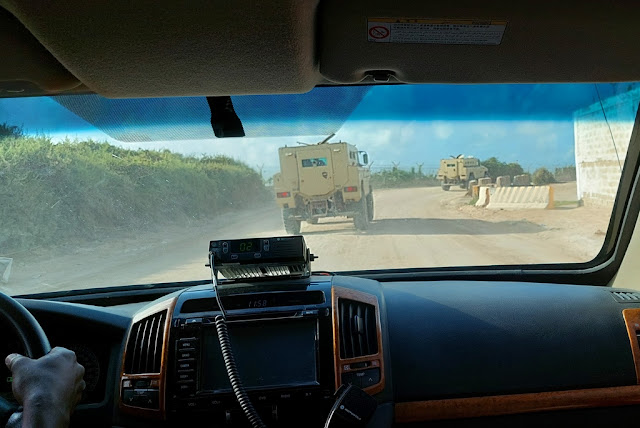
Anyway, we were soon in the armored
vehicle and winding our way through the streets of Mogadishu. One of the
reasons I like taking guests to the Lido is that it requires a trek across the
city. It’s a fascinating place with loads of contrasts. New buildings. Old,
bombed out buildings. It’s good to get out of the office/guesthouse and see
something. Often there’s a tendency to focus on meetings and emails.

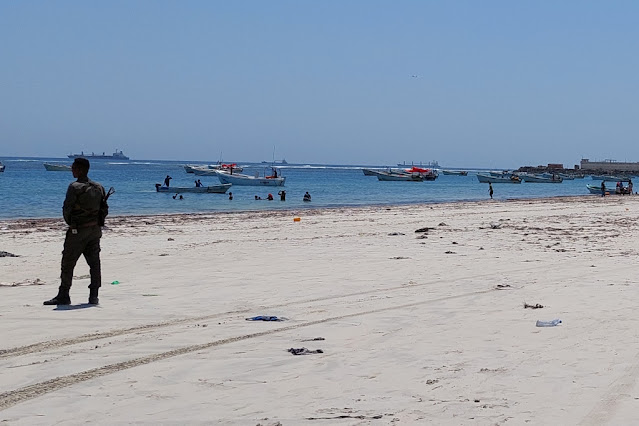
After you enter the restaurant
compound, you walk from the rather trashy parking area, through a walkway and
gradually you see the turquoise waters of the Indian Ocean appearing from the
other side. There’s always a steady breeze blowing through the open restaurant
keeping temperatures rather comfortable. We walked through and down to the
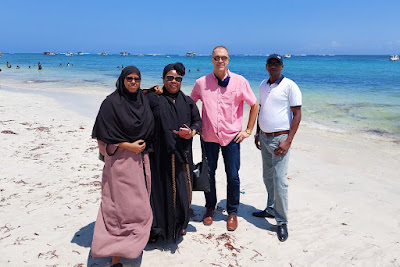
beach. I always feel the need to touch the water as a sort of ritual. After taking
some photos (flanked by guards), we retreated to the upper floor of the
restaurant where we would have fresh juices, seafood, fruit and, in my case, an
espresso to finish off the meal. It’s a wonderful Somali experience.
Then it was back to the vehicle
and back to the streets of the city. We generally take a different route each
time for security reasons. But I’ve done this enough that I’m getting increasingly
familiar with the city. I long for the day when the extra security is no longer
needed and I could just walk around with a camera and enjoy the city. Not sure
this can happen in my lifetime.
The next few days were packed with
various meetings, some at the airport compound, some internal, one in a nearby
restaurant. It’s always good to meet with partners and spend time with staff
but it’s exhausting after a while. But I was able to meet the UK ambassador,
the head of the UN in Somalia, and many others.
* *
*
I had an interesting interaction
with one of the African Union (AU) guards one morning while entering the compound.
He asked for my ID and as he looked at it he grinned. He looked at me, nodding his
head slightly and looking over the top of his sunglasses and said, “Instructor!”
“Sorry?”, I replied. I wasn’t sure
what he was talking about.
“You were my instructor,” he said
as he handed me back my passport. My mind was racing to try to figure out what
he was referring to. Suddenly I thought back to my time in Bujumbura. Back in
2013-2014, I was asked to provide a sort of international community relations training
to AU soldiers. Burundi has been a contributor of peacekeeping troops to
Somalia for many years and learning how to interact with UN and international
organizations was part of their overall training prior to being deployed.
Little did I know at the time that one day I’d actually end up working in
Somalia.
Without seeing the flag patch on
the guy’s shoulder, I quickly assumed that this was what he was referring to –
though quite a stretch that my very brief part in his training could still be
recalled so many years later.
“You remember me?” I asked.
“How could I forget? You were my favorite
instructor in the Rangers Course in 2017.”
By now I could see the patch on
his left shoulder was the Ugandan flag. I smiled to myself that indeed, this
was a case of mistaken identity. Too complicated to undo (and I was in a hurry),
I just left it and told him thanks, that it was good to see him and to have a
nice day.
I have been told on occasion that
I look like I’m military, or former military. In fact we were in a mall in the US
one time when our girls were little. I was sitting on a bench and the kids were
playing while Priya was off buying Christmas gifts. A woman who was sitting on
an adjacent bench looked over at me and said out of the blue, “I just want to
thank you for all that you are doing for our country.” I smiled and told her I
wasn’t in the military but it was a kind thing to say. She apologized for the
mistake, saying that she was sure I was a soldier. Must be my haircut.
* *
*
Having been in the US for a couple
weeks not long before heading to Somalia, I was missing my family more than
usual. I don’t have much stamina when it comes to spending time away from them.
I was quickly counting the days until I would be back in Nairobi listening to
my girls discuss in detail their Halloween costume plans.
On the morning of my departure day,
I had a brief discussion with one of my supply chain staff. I asked him about the
support he has been providing on one particular organizational initiative. Generally
my discussions with the team are in English and their command of the language
varies quite a bit from one person to the next. My fault since I should have
learned Somali by now.
“I’ve been hardly working on it,”
he said. My eyebrows raised momentarily. “It has been a big priority.”
I quickly realized the confusion
as I tapped into my former English teacher self. “Hard” can be an adverb, as in
“I worked hard”. Likely, because he’s more familiar with “ly” adverbs, he felt
he needed the suffix. Unfortunately, in a rather interesting and confusing twist
in the English language, his very slight mistake conveyed the exact opposite of
the intended meaning. At least I thought it was interesting.
* *
*
The travel home was blissfully uneventful,
at least compared to expectations. For someone who’s not accustomed to travel
between Mogadishu and Nairobi, it might not be considered blissfully
uneventful. It might be more akin to an annoying labyrinth. Somalis are not big
on signage, unless maybe it’s advertising. When you first arrive, there’s no
sign directing you where you need to go. I just know having done it dozens and dozens
of times. There’s a small, sheltered area where you need to leave your bag unattended
(breaking a cardinal sin of travel) and wait for a guy to come through with a
sniffer dog. Once you get your bag there’s no indication as to where you go
next. No sign directing you to international departures which is still more
than a hundred meters away around the terminal to the left. Then you go through
another security check and then onto to check-in. From there, there is no
indication that you need to go to a Ministry of Health window to get a stamp on
your negative Covid test certificate (had to wait 20 minutes for the lady to
show up). After that, there’s no indication that you need to go to another desk
(some sort of manifest check) where a guy stamps your boarding pass (had to
wait 10 minutes for him as well). You just need to know. Without these two stamps,
you can’t get through immigration. Your Covid documents are checked at each
step.
Once you get through the immigration,
you have another security check. At both this one and the one before, you need
to fire up your laptop/tablet to demonstrate that it works. Then they swab it
to see if it has an explosive material in it.
Once you’re through this one, you
move to the gate area (preferably after picking up a cold water) where your
carry-on has yet another sniffer dog check – the fourth security check. One would
think that would finally be the end of security checks. Alas, no. When you
arrive in Nairobi, the only flights where passengers are subjected to
on-arrival security screenings are those from Somalia. It’s a full-on check as if
you’re departing. Then, after they check your Covid test documents, you go
through Kenyan immigration and, believe it or not, there is yet one last conveyor
belt security check (the sixth one for your traumatized little carry-on)
before you leave the terminal.
Like I said, blissfully
uneventful, so long as you know all this is coming and all your documents are
in order and ready for viewing.
* *
*
The early evening taxi ride through
Nairobi was warm. Between the time I left for the US and now, the season had
clearly changed. We’re only two hundred kilometers (124 miles) south of the
equator but we’ve clearly moved into “summer”. Seasonal differences are minimal
compared to most of the world but there are still seasons.
Upon arrival at home, I greeted my
sun-kissed family. The girls are on holiday so the rest of my family spent the
week at a resort on the coast with a couple of other families. They had just
arrived a few hours prior. Would have been nice to hang out at the beach with
them but oh well. Good to be back together.


